Category Archives: COVID19

COVID19 Video Informative

This video, produced by a colleague, is very informative.

Sleep well, exercise outdoors, laugh, love, engage in meaningful work, drink filtered water, eat clean, eat whole foods, get plenty of sunshine, spend time with those you love.

Doctor Bob

COVID-19 Suppression until vaccine (18 months) recommended by new report.

report from the Imperial College in UK summarizes the results of a model utilizing the most up to date data available. Very sobering!!

Some key points.

We find that that optimal mitigation policies (combining home isolation of suspect cases, home quarantine of those living in the same household as suspect cases, and social distancing of the elderly and others at most risk of severe disease) might reduce peak healthcare demand by 2/3 and deaths by half.

However, the resulting mitigated epidemic would still likely result in hundreds of thousands of deaths and health systems (most notably intensive care units) being overwhelmed many times over.

For countries able to achieve it, this leaves suppression as the preferred policy option.

We show that in the UK and US context, suppression will minimally require

  • a combination of social distancing of the entire population,
  • home isolation of cases and household quarantine of their family members.
  • This may need to be supplemented by school and university closures

The major challenge of suppression is that this type of intensive intervention package – or something equivalently effective at reducing transmission – will need to be maintained until a vaccine becomes available (potentially 18 months or more) – given that we predict that transmission will quickly rebound if interventions are relaxed.

We show that intermittent social distancing – triggered by trends in disease surveillance – may allow interventions to be relaxed temporarily in relative short time windows, but measures will need to be reintroduced if or when case numbers rebound

Last, while experience in China and now South Korea show that suppression is possible in the short term, it remains to be seen whether it is possible long-term, and whether the social and economic costs of the interventions adopted thus far can be reduced.

Certainly this is very sobering. We are in this for the long haul. Reports of some beneficial effects of drugs presently used for other purposes are providing hope for the critically ill.

Various cities and counties have instituted curfews and local ordinances, closing non-essential business under penalty of criminal charges. These measures are necessary for immediate mitigation and suppression.

San Francisco  instituted a “shelter in place” starting at 12:01am this morning in order to enforce enhanced social distancing measures. Again, a wise measure in a hot zone.

Anthony Fauci MD, Director of Infectious Disease and Allergy at NIH has sated “if someone tells you that you are over-reacting then you are doing it right”.

“Younger people should be concerned for two reasons. You are not immune or safe from getting seriously ill. Even though when you look at the total numbers, it’s overwhelmingly weighted toward the elderly and those with underlying conditions. But the virus isn’t a mathematical formula. There are going to be people who are young who are going to wind up getting seriously ill.

So protect yourself, but remember that you can also be a vector or a carrier. And even though you don’t get seriously ill, you could bring it to a person, who could bring it to a person, that would bring it to your grandfather, your grandmother or your elderly relative. That’s why everybody has to take this seriously, even the young.”

Too many in our community are under-estimating the gravity of this situation and the measures necessary to save lives. Those who ignore these recommendations increase risk for their families, friends, and society at large.

Stay at home except for necessities which include food, medicines, urgent medical care.

Immediately wash your hands with soap and water for at least 20 seconds when you come home or come in contact with anything from the outside. Soap and water more effective than hand sanitizer.

Wipe down hard surfaces with Clorox type disinfectants in kitchen, bathroom, phone, door knobs, car door handles, steering wheels, etc.

When out in public for necessities wear gloves, eye protection. Disinfect shopping cart handles before touching them AND wear gloves.

Any item brought into the home handled by other folks should be wiped with disinfectants.

Wash clothing and sheets frequently. Droplets from asymptomatic carriers of COVID-19 can remain on clothing and hard surfaces for a few days and remain infectious. If a retail worker touches their face then touches the item you purchase (or coughs or sneezes on an item) it could transmit disease.

Keep your immune system optimal:

  1.  No alcohol. Alcohol suppresses the immune system for several days
  2.  Get plenty of sleep, at least 8 hours.
  3. Follow good sleep habits.
  4.  Eat an anti-inflammatory diet.

Stay safe.

Sleep well, exercise outdoors, laugh, love, engage in meaningful work, drink filtered water, eat clean, eat whole foods, get plenty of sunshine, spend time with those you love.

Doctor Bob

COVID19 Interactive Tool

Here is the link to a great interactive tool that shows the risk reduction or increase with early/aggressive vs. late/mild intervention with respect to social distancing etc. I highly recommend visiting this site. You can move the time line through various scenarios. The site also provides very useful information. Hat tip to my friend Joe Andresen MD for sending me the link.

Be Safe.

Doctor Bob

John’s Hopkins daily update on COVID19

Here it is, you can subscribe to receive daily email update.

Stay safe.

Daily updates on the emerging novel coronavirus from the Johns Hopkins Center for Health Security.
The Center for Health Security will be analyzing and providing updates on the emerging novel coronavirus. If you would like to receive these daily updates, please sign up here and select COVID-19. Additional resources are also available on our website.
March 13, 2020
Note: although we include case counts to help provide situational awareness to our readers, the numbers are constantly changing. Please refer to the WHO or the public health agencies of affected countries for the latest information.
EPI UPDATES The WHO COVID-19 Situation Report shows a total of 125,048 confirmed cases (4,613 deaths) worldwide. There have been 6,729 new cases in the past 24 hours. French Polynesia, Turkey, Honduras, and Cote d’Ivoire have all reported their first COVID-19 cases in the last day. The Johns Hopkins Center for Systems Science and Engineering (CSSE) dashboard is reporting 137,066 cases and 3,337 total deaths as of noon today. Iran’s Ministry of Health reported 1,289 new cases of COVID-19 and 85 new deaths, bringing the total there to 11,364 cases and 514 deaths. The Italian Ministry of Health reported a total of 12,839 cases and 1,016 deaths. The Singapore Ministry of Health reported200 total cases, of which 103 are currently hospitalized and 11 are in critical condition. Spain reported a total of 4,209 cases and 120 deaths. The US CDC reported a total of 1,215 cases and 36 deaths across 42 states and Washington, DC. Of those cases, 125 are travel-related, 102 are close contacts of known cases, and 988 are still under investigation.
The South Korean CDC reported a total of 7,979 confirmed COVID-19 cases, including 67 deaths. Epidemiological links have been identified for 79.8% of cases. The most recent report provides an updated breakdown of cases by region, sex, and age group, providing additional insight into the ongoing epidemic. Females represent 61.9% of cases but only 41.8% of deaths. The unadjusted case fatality ratio for individuals aged 80 years and older is 8.30% (21 deaths out of 253 cases), and it is 4.74% for those 70-79 years old and 1.42% for those 60-69 years old. For cases under the age of 60, the case fatality ratio is only 0.12%. Notably, there have been only 2 deaths below the age of 50, despite 4,712 confirmed cases. The epidemic in South Korea has been driven largely by the community around the Shincheonji religious group (4,780 cases; 59.9% of all cases).
REPORTS OF HEALTH SYSTEM BURDEN IN ITALY The New York Times reported that Italy’s health system has become rapidly overwhelmed in just 3 weeks, leading to severely limited availability for ventilators and necessitating difficult decisions regarding how ration medical care among patients. The rapid spread and increase in the number of severe cases prompted Italy to enforce radical social distancing measures and to strongly encourage other countries to rapidly implement these measures as well. As reported yesterday, Italy implemented strict quarantine measures nationwide, including closing many businessesPeople will still be able to access public areas under certain conditions, but they are encouraged to remain at home and avoid non-essential gatherings. A pre-print recent report from faculty here at the Johns Hopkins Center for Health Security and collaborators also addresses the need for rapid implementation of social distancing measures to slow the spread of epidemic and mitigate health system burden.
SINGAPORE ANNOUNCES NEW RESTRICTIONS Singaporerecently expanded its travel restrictions to include visitors with travel history to Italy, France, Spain, and Germany in the last 14 days. These individuals will not be allowed entry or transit through the country, and those already in the country with travel history from those countries will receive stay-at-home notices. Singapore already had travel restrictions in place for China, Iran, and South Korea.
US RESPONSE The US Senate will cancel the recess scheduled to begin today in order to remain in session to draft and debate legislation related to the US COVID-19 response. Senate Majority Leader Mitch McConnell was under pressure, including from fellow Republican Senators, to keep the Senate in session in order to finalize coronavirus legislation. The US House of Representativesand the White House are still negotiating a legislative package that aims to address economic and other effects of the COVID-19 epidemic in the United States. Reportedly, the bill is close to being finalized, with hopes that the House of Representatives could vote on it today. Key issues include free coronavirus testing, paid sick leave for COVID-19 patients, and increased support for states to address funding for unemployment and food assistance programs.
According to NPR, the Office of Personnel Management now requires agencies to incorporate telework into their continuity of operations plans, reversing a trend of scaling back telework infrastructure among government employees in recent years.
ECONOMIC DECLINES CONTINUE TO BEAR MARKET NPRreported that recent wide-scale stock sell-offs have now led to the start of a “bear market,” which could potentially forecast an impending recession. The Dow Jones Industrial Average has dropped 28% since its high point on February 12. The South China Morning Post also reported similar declines in Asian financial markets.
US SCHOOL CLOSURES AND SOCIAL DISTANCING MEASURES Note: for the most up to date information about individual communities, please visit the relevant jurisdiction’s website directly. Ohio Governor Mike Dewine announced that all K-12 schools will be closed through April 3, and the state banned all mass gatherings of more than 100 people. Michigan Governor Gretchen Whitmer also announced that all K-12 schools will be closed through April 5. Notably, Governor Whitmer also expanded access to telemedicine statewide, and she called for President Trump to initiate a special enrollment period for the ACA to ensure access to healthcare during the COVID-19 pandemic. Maryland Governor Larry Hogan announced closure of all schools through March 27 as well as a series of other response measures, including a ban on gatherings larger than 250 people, the closure of cruise ship terminal in Baltimore, and the activation of the Maryland National Guard to support the response. The announcement comes on the heels of Maryland detecting its first reported instance of community SARS-CoV-2 transmissionWashington, DC, public schools will be closed from March 16 – March 31. Spring Break for these schools has been rescheduled for March 17-23 (formerly scheduled for April), and students will participate in distance learning from March 24-31. Meals will be made available for all students during that period at designated schools throughout the District.
In addition to Ohio, Michigan, Maryland, and Washington, DC, several other states have closed schools in certain higher-risk areas. Washington Governor Jay Inslee ordered K-12 schools closed in King, Pierce, and Snohomish counties through April 24, affecting 600,000 students in high-risk areas. Schools in San Francisco and part of nearby Contra Costa County in California are also closed, but the state has not mandated closures statewide. Pennsylvania Governor Tom Wolfe announced that schools in Montgomery County (13 reported cases) will be closed for 2 weeks. Pennsylvania is also mandating remote work for state employees, and the state is implementing a 10-day paid leave policy for individuals who cannot work remotely. The governors in Georgia and Kentucky both recommended that schools consider closing, but they did not mandate closures.
Many government agencies are recommending or mandating that people avoid crowded spaces and large gatherings, particularly if they are exhibiting COVID-19 symptoms, but this may be more difficult (or impossible) for individuals experiencing homelessness. In Washington, DC, the Department of Health Services (DHS) is coordinating with homeless shelters and local healthcare systems to provide support for these individuals who may need to undergo quarantine. DHS Director Laura Zeilinger said that individuals who seek care for symptoms would not be returned to shelters or other congregate settings. DHS is also providing additional assistance to increase access to hand sanitizer and improve hygiene and sanitation at shelters and locations where food is served.
Considering the elevated risk to older individuals, some adult long-term care facilities (e.g., nursing homes) are taking additional measures to protect their residents and patients. As seen in Seattle, nursing homes can be high-risk environments for spreading SARS-CoV-2 among a particularly vulnerable population. Nursing homes are beginning to screen and limit visitors in order to reduce their residents’ risk of exposure, and efforts are ongoing to increase the quality and effectiveness of disinfection and hygiene efforts to reduce the risk of transmitting within facilities. Concerns remain, however, about the toll of prolonged isolation from friends and family for residents of these facilities.
The NCAA announced yesterday that all remaining winter and spring sports championships, including the Men’s and Women’s basketball national championships (also known as March Madness), are cancelled due to concerns about coronavirus. The NHL announced yesterday that it is suspending the 2019-20 seasonindefinitely. Major League BaseballMinor League Baseball, and Major League Soccer all announced a range of cancelations, restrictions, or suspensions in response to COVID-19 as well. Additionally, officials from the Boston Athletic Association and Boston Mayor Martin Walsh announced that the Boston Marathon will be postponed until September 14.
CLINICAL COURSE OF COVID-19 A study published on March 11 in The Lancet provides analysis of the progression of the COVID-19 disease in survivors and non-survivors. The study involved 191 hospitalized COVID-19 patients (54 deaths, 137 discharged) in Wuhan, China. Notably, the study describes the timing of various aspects of disease progression in hospitalized patients, including the time from first symptom onset to the onset of various symptoms/conditions, including dyspnoea, sepsis, and ARDS as well as their duration. The article also reports the time to and duration of ICU admission. The study found an increase in the odds of death with increased age, and the mean duration of viral shedding was 20 days from symptom onset in survivors and continuously until death in non-survivors (maximum duration: 37 days). The study found no evidence that antiviral treatment reduces the duration of viral shedding.
SPOUSE OF THE PM OF CANADA TESTED POSITIVE Prime Minister Justin Trudeau’s wife, Sophie Grégoire Trudeau, tested positive for SARS-CoV-2, according to a statement by the Prime Minister’s Office. At this time, her symptoms do not appear to be serious, and she will be self-isolating for at least 14 days. Prime Minister Trudeau will not be tested at this time because he is not exhibiting symptoms, but he will self-quarantine for 14 days as well. He does not expect this to affect his duties as Prime Minister. There are growing reports of political leaders from various countries becoming infected or exposed to COVID-19.

Too late for containment, now we must flatten the curve of COVID19

We are past the point of containment, COVID19 is here. A travel ban from Europe (announced by Trump) is useless. It will cause harm by  diverting resources from truly effective measures. Yes, travel bans cost money and resources to implement, money and resources better spent elsewhere.

Experts advise that we must flatten the curve of COVID19 spread to prevent overwhelming our medical facilities and personnel. The US has a finite number of ICU beds, hospital beds, doctors, nurses and technicians. In fact the number of hospitals and hospital beds has dropped considerably compared to other countries.

FROM MSN:

“The limits of America’s hospital system are an unexpected downside of progress in efficiency, advances in technology and pharmaceutical breakthroughs that have made it easier to keep patients out of the hospitals. Insurers have accelerated the trend by steering patients to less-costly care, pushing for more procedures to be done on an outpatient basis, often outside hospital walls. The number of hospital beds—and hospitals—has contracted in recent decades, dropping 16% and 12%, respectively, between 1975 and 2018, according to survey data from the American Hospital Association. 

After years of consolidation and scaling back on construction, with the sector pouring more capital into outpatient centers, the system has less capacity for surges in demand.

U.S. hospital beds per American have declined in the past two decades to a ratio of 2.8 beds for every 1,000 people as of 2016. That ranks among the lowest across comparable countries, a Kaiser Family Foundation analysis of Organization for Economic Cooperation and Development data shows. The average across those countries, including Japan, Germany and Australia, is 5.4 beds per 1,000 people.”

So what does it mean to “flatten the curve?

We must take measures that will slow down the rise of cases and flatten the peak so that our resources can handle a lower and more widely spread peak. There will be a critical point where if more sick cases appear not everyone will get the care they need (no more ventilators, no more ICU beds, etc.) That point is represented by the Health care system capacity line below.
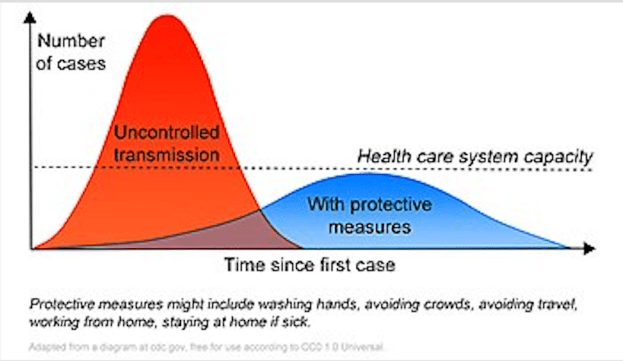
flatten curve 3.png

SOCIAL DISTANCING:

Social distancing includes avoiding crowded spaces such as theatres, museums, concerts, public gatherings. What size constitutes a “crowd”? The cutoff is arbitrary. The NBA and NHL have canceled their seasons. NYC has closed museums and Broadway theatres are closed. More stringent social distancing closes smaller venues. This sort of activity requires effective leadership which presently is coming from states and local governments. (Trump has failed to lead us. He has ignored and contradicted expert opinion from CDC etc. More about that another time.)

OTHER MEASURES:

As indicated in the above graph depicting flattening the curve, we as individual citizens can help flatten the curve.

  1.  Wash hands frequently (at least 20 seconds with soap and water)
  2.  Work from home whenever possible
  3.  If you are sick, stay at home, do not spread the virus.
  4.  Cover your nose and mouth with your arm when coughing or sneezing
  5.  Immediately dispose of used tissue paper.

Many people do not have paid sick time. That is why immediate federal legislation to support sick people so they can stay home is vitally important. That leadership is thankfully coming from Nancy Pelosi.

FROM NPR: “House Speaker Nancy Pelosi says her chamber will move forward Friday with a legislative package to handle the coronavirus pandemicthough Republicans don’t fully support it. The deal taking shape includes paid sick leave, nutrition aid and assistance for states, including unemployment and Medicaid costs.”

THESE MEASURES ARE VITALLY IMPORTANT. WHEN FACED WITH A DECISION TO STAY HOME WHEN SICK MEANS NO FOOD ON THE TABLE AND NO RENT CHECK, PEOPLE ARE MORE LIKELY TO MAKE THE DECISION TO FEED THEIR FAMILY and go to work. But that will expose others to the virus and cause a peak in infections, potentially overloading our medical system. The federal government must take measures that make it economically possible for sick folks to stay home and avoid rapidly infecting others.

Closing schools and shifting to on-line classes can help slow the spread.

FROM NPR: Every day for the past week, more than 100 colleges and universities around the country have canceled in-person classes and have taken the unprecedented step of moving classes online

This is an important example of social distancing.

From NPR: “According to a report in Education Week, at least 10,600 schools have been closed or are scheduled to close for several weeks. That is a small but quickly growing fraction of the approximately 50 million K-12 students in the United States.”

But closing K-12 places some children at increased risk as discussed below.

PROTECTING OUR CHILDREN:

FROM NPR: The Life Kit team looks at what you need to know about working from home and parenting young children.

And from that website link here are some important quotes.

“Luckily, public health officials in King County, Washington, offer this helpful guidance:

“Social distancing doesn’t mean you have to stay stuck in your house. … The current recommendation is to avoid large groups. That mostly means groups over 50 people but conservatively means anything more than 10 people. However, if you don’t fall into the high risk group, you can still certainly visit each other.”

Think of it as a good opportunity for one-on-one hangouts.

  1. What’s the single most important thing we can do to protect our kids?

Make sure they understand that hand-washing isn’t optional. And that means showing them how to do it properly: using soap, warm water and time. Washing should take 20 seconds, which means you may need to help them find a song they can sing (in their heads, maybe twice) — like the ABCs or “Happy Birthday” songs. Be sure they wash whenever they come in from outside, before eating, after coughing or sneezing or blowing their nose and, of course, after using the bathroom.

GOATS AND SODA

Just For Kids: A Comic Exploring The New Coronavirus

For younger kids, it can’t hurt to remind them that nose-picking is a no-go, and that they should cough into their elbows. If you’re feeling ambitious, clip their fingernails frequently, as they provide a sneaky hiding spot for viruses. Hand lotion keeps skin comfy and unbroken, which also helps prevent the spread of infection.

  1. Why is/isn’t my school being closed?

Closing schools is a complicated decision. Many school leaders and public health officials seem to be waiting for an infection or potential infection in their immediate school community before closing. While the science suggests closing schools earlier is more effective at slowing the spread of disease, it’s important to understand why so many school leaders are so reluctant to close schools.

For one thing, parents should understand that for many kids in the United States, being sent home from school is also a public health risk. Many children may not have parents who can take off work, or work from home, if school is canceled. They may also live in unsafe neighborhoods. Millions of U.S. children rely on schools for free or reduced-price meals, too, and 1.5 million schoolchildren nationwide are housing-insecure. For many of these kids, having to miss several weeks of school could be incredibly destabilizing.

A few more ideas: Try laundering things like coats, backpacks and reusable shopping bags more frequently and take off shoes when you come inside. For cleaning the house, the Centers for Disease Control and Prevention says “diluted household bleach solutions, alcohol solutions with at least 70% alcohol, and most common EPA-registered household disinfectants should be effective.”

If you have not read my first 2 posts about COVID19 please do so.

Remember, many infected people have no or little symptoms but they can still transmit the disease. High risk individuals include the elderly and those with chronic disease, especially cardiovascular disease, pulmonary (COPD, asthma, emphysema, smokers) and diabetics. Anyone on immune suppressive drugs is at very high risk.

Do everything you can to support your immune system:

  1.  Get adequate sleep
  2.  Practice stress reduction techniques
  3.  Walk outdoors in a greenspace
  4.  Eat an anti-inflammatory diet
  5.  Avoid environmental toxins
  6.  Avoid endocrine disruptors

THIS WEBSITE PROVIDES INFORMATION FOR EDUCATIONAL PURPOSES ONLY. CONSULT YOUR HEALTH CARE PROVIDER FOR MEDICAL ADVICE.

Eat clean, drink filtered water, love, laugh, exercise outdoors in a greenspace, get some morning sunlight, block the blue light before bed, engage in meaningful work, find a sense of purpose, spend time with those you love, AND sleep well tonight.

 Doctor Bob



Droplets vs Aerosol spread, COVID19

I spoke to a friend who was the Public Health Officer for Sacramento County for many years. She still consults on infectious disease and public health.

There is an important distinction between DROPLET spread and AEROSOL spread.

TB and measles are examples of AEROSOL spread. If someone coughs or sneezes in a room the particles can remain suspended in the air for long periods of time. So if you walk into the room after someone coughs or sneezes you can get the disease. This transmission requires “negative pressure” rooms in a hospital for isolation.

Corona virus and flu were believed to be different. They were thought to be spread by droplets which do not remain suspended in the air. The infected person must sneeze or cough droplets in your face or you must get the droplets from a contaminated surface (example: door knob) and then touch your face. In hospitals this requires only closing the door of the hospital room, not a negative pressure room (the negative pressure does not allow the aerosol to leave the room and it filters the room air).

Since this original post more scientific data have become available that strongly suggest that aerosol spread can occur with SARS CO2, (COVID-19) in community circumstances. Likelihood of transmission increases depending on many variables:

  • enclosed space (meeting room, bar, restaurant, living room, etc.)
  • poor ventilation (windows not open, air turnover from HVAC slow)
  • duration of exposure (time spent in enclosed area, or outside face to face contact)
  • proximity of individuals to one another (need to wear effective masks and socially distance)
  • proximity to air flow from HVAC system which can circulate aerosol
  • viral load of infected individual
  • immune status of individual
  • yelling, loud talking, singing, coughing, sneezing, dramatically increase aerosol and droplet production and transmission distance

Masks and social distancing decrease spread.

Some never develop symptoms. Asymptomatic individuals can carry and transmit the virus.

In individuals who develop symptoms, transmission can occur several days before symptoms appear.

Surfaces like doorknobs, keyboards, tables are not as important as previously thought. If someone is sick OR infected but not symptomatic with COVID19, the virus was thought previously to be transmitted by contact with a surface like a doorknob. cleaning these surfaces with Clorox or similar virus killing antiseptics was considered essential. Now we know that transmission by that route is much less important. AEOROSOL TRANSMISSION is the primary mode of transmission.

Nevertheless, frequent handwashing (at least 20 seconds) would be prudent.

Important: PUBLIC HEALTH RECOMMENDATIONS FOR INDIVIDUALS OVER AGE 65 AND THOSE WITH CHRONIC DISEASE INCLUDE VACCINATION FOR PNEUMOCCOUS. Contracting pneumococcal pneumonia before or after COVID19 would be very dangerous.

It is unlikely that there will be an effective COVID19 vaccine for a long time, if ever. Why? Because corona viruses MUTATE QUICKLY. There has never been an effective corona virus vaccine. But huge resources are now devoted to developing a vaccine and new technologies and approaches are being tried. (This was posted March 12, 2020, 9 months later a vaccine was available. However the “MUTATE QUICKLY” concern has proven true. As of 11/12/2022 we are still dealing with rapidly developing mutations with increasing immune evasion characteristics. But we have PAXLOVID, a combination anti-viral that is very effective in reducing morbidity, mortality, and risk of LONG COVID.

In the context of the COVID 19 pandemic I will close with the usual summary.

  1. Avoid alcohol consumption (alcohol wreaks havoc with your immunity)
  2. Get plenty of sleep (without adequate sleep your immune system does not work well )
  3. Follow good sleep habits
  4. Exercise, especially out of doors in a green space, supports the immune system
  5. Get some sunshine and make sure you have adequate Vitamin D levels. Supplement with Vitamin D3 to get your levels above 30 ng/ml, >40ng/ml arguably better.
  6. Eat an anti-inflammatory diet rich in micronutrients.
  7. Practice stress reduction like meditation and yoga which improves the immune system
  8. Eliminate sugar-added foods and beverages from your diet. These increase inflammation, cause metabolic dysfunction, and suppress immunity.
  9. Eliminate refined-inflammatory “vegetable oils” from your diet, instead eat healthy fat.
  10. Clean up your home environment and minimize your family’s exposure to environmental toxins by following recommendations at EWG.org with regards to household products, personal care products, and organic foods. (https://www.ewg.org/)
  11. Drink water filtered through a high quality system that eliminates most environmental toxins.
  12. HEPA filters or the home-made version (Corsi-Rosenthal box) used in your home or workplace can reduce circulating viral load as discussed on this website.
  13. If you are eligible for vaccination, consider protecting yourself and your neighbor with a few jabs. Age > 50 and/or risk factors (Diabetes, pre-diabetes, insulin resistance, hypertension, obesity, heart disease, COPD, asthma, cancer treatment, immune suppression) suggests benefit from a booster. Risk for complications of boosters in adolescents, especially males, without risk factors, may equal benefit. Previous infection with Covid can be considered as protective as a booster. Discuss risk vs benefits with your doctor.

THIS WEBSITE PROVIDES INFORMATION FOR EDUCATIONAL PURPOSES ONLY. CONSULT YOUR HEALTH CARE PROVIDER FOR MEDICAL ADVICE.

Eat clean, drink filtered water, love, laugh, exercise outdoors in a greenspace, get some morning sunlight, block the blue light before bed, engage in meaningful work, find a sense of purpose, spend time with those you love, AND sleep well tonight.

 Doctor Bob

COVID19 UPDATE, UCSF CONFERENCE REPORTS FRIGHTENING INFORMATION, posted March 12, 2020

On March 10, 2020 a panel discussion/conference of Infectious Disease and PANDEMIC experts convened at UCSF (University of California San Francisco). Here are the panelists.

  • Panelists
    • Joe DeRisi:  UCSF’s top infectious disease researcher.  Co-president of ChanZuckerberg BioHub (a JV involving UCSF / Berkeley / Stanford).  Co-inventor of the chip used in SARS epidemic.
    • Emily Crawford:  COVID task force director.  Focused on diagnostics
    • Cristina Tato:   Rapid Response Director.  Immunologist.
    • Patrick Ayescue:   Leading outbreak response and surveillance.  Epidemiologist.
    • Chaz Langelier:   UCSF Infectious Disease doctor

Unless bracketed, these are direct quotes of the panelists. This was forwarded to me by a physician friend whose colleague prepared it. The “I” refers to that colleague.

University of California, San Francisco BioHub Panel on COVID-19

March 10, 2020

  • Top takeaways 
    • At this point, we are past containment.  Containment is basically futile.  Our containment efforts won’t reduce the number who get infected in the US.  
    • Now we’re just trying to slow the spread, to help healthcare providers deal with the demand peak.  In other words, the goal of containment is to “flatten the curve”, to lower the peak of the surge of demand that will hit healthcare providers.  And to buy time, in hopes a drug can be developed. 
    • How many in the community already have the virus?  No one knows.
    • We are moving from containment to care.  
    • We in the US are currently where Italy was a week ago.  We see nothing to say we will be substantially different.
    • 40-70% of the US population will be infected over the next 12-18 months.  After that level you can start to get herd immunity.  Unlike flu this is entirely novel to humans, so there is no latent immunity in the global population.
    • [We used their numbers to work out a guesstimate of deaths— indicating about 1.5 million Americans may die.  The panelists did not disagree with our estimate.  This compares to seasonal flu’s average of 50K Americans per year.  Assume 50% of US population, that’s 160M people infected.  With 1% mortality rate that’s 1.6M Americans die over the next 12-18 months.]  
      • The fatality rate is in the range of 10X flu.
      • This assumes no drug is found effective and made available.
    • The death rate varies hugely by age.  Over age 80 the mortality rate could be 10-15%.  [See chart by age Signe found online, attached at bottom.]
    • Don’t know whether COVID-19 is seasonal but if is and subsides over the summer, it is likely to roar back in fall as the 1918 flu did
    • I can only tell you two things definitively.  Definitively it’s going to get worse before it gets better.  And we’ll be dealing with this for the next year at least.  Our lives are going to look different for the next year.
  • What should we do now?  What are you doing for your family?
    • Appears one can be infectious before being symptomatic.  We don’t know how infectious before symptomatic, but know that highest level of virus prevalence coincides with symptoms.  We currently think folks are infectious 2 days before through 14 days after onset of symptoms (T-2 to T+14 onset).
    • How long does the virus last?
      • On surfaces, best guess is 4-20 hours depending on surface type (maybe a few days) but still no consensus on this
      • The virus is very susceptible to common anti-bacterial cleaning agents:  bleach, hydrogen peroxide, alcohol-based.
    • Avoid concerts, movies, crowded places.
    • We have cancelled business travel.
    • Do the basic hygiene, eg hand washing and avoiding touching face.
    • Stockpile your critical prescription medications.  Many pharma supply chains run through China.  Pharma companies usually hold 2-3 months of raw materials, so may run out given the disruption in China’s manufacturing.
    • Pneumonia shot might be helpful.  Not preventative of COVID-19, but reduces your chance of being weakened, which makes COVID-19 more dangerous.
    • Get a flu shot next fall.  Not preventative of COVID-19, but reduces your chance of being weakened, which makes COVID-19 more dangerous.
    • We would say “Anyone over 60 stay at home unless it’s critical”.  CDC toyed with idea of saying anyone over 60 not travel on commercial airlines.
    • We at UCSF are moving our “at-risk” parents back from nursing homes, etc. to their own homes.  Then are not letting them out of the house.  The other members of the family are washing hands the moment they come in.
    • Three routes of infection
      • Hand to mouth / face
      • Aerosol transmission
      • Fecal oral route
  • What if someone is sick?
    • If someone gets sick, have them stay home and socially isolate.  There is very little you can do at a hospital that you couldn’t do at home.  Most cases are mild.  But if they are old or have lung or cardio-vascular problems, read on.
    • If someone gets quite sick who is old (70+) or with lung or cardio-vascular problems, take them to the ER.
    • There is no accepted treatment for COVID-19.  The hospital will give supportive care (eg IV fluids, oxygen) to help you stay alive while your body fights the disease.  i.e. to prevent sepsis.
    • If someone gets sick who is high risk (eg. is both old and has lung/cardio-vascular problems), you can try to get them enrolled for “compassionate use” of Remdesivir, a drug that is in clinical trial at San Francisco General and UCSF, and in China.  Need to find a doc there in order to ask to enroll.  Remdesivir is an anti-viral from Gilead that showed effectiveness against MERS in primates and is being tried against COVID-19.  If the trials succeed it might be available for next winter as production scales up far faster for drugs than for vaccines.  [MoreI found online.]
    • Why is the fatality rate much higher for older adults?
      • Your immune system declines past age 50
      • Fatality rate tracks closely with “co-morbidity”, i.e. the presence of other conditions that compromise the patient’s health, especially respiratory or cardio-vascular illness.  These conditions are higher in older adults.
      • Risk of pneumonia is higher in older adults.
  • What about testing to know if someone has COVID-19? 
    • Bottom line, there is not enough testing capacity to be broadly useful.  Here’s why.
    • Currently, there is no way to determine what a person has other than a PCR test.  No other test can yet distinguish “COVID-19 from flu or from the other dozen respiratory bugs that are circulating”.
    • A Polymerase Chain Reaction (PCR) test can detect COVID-19’s RNA.  However they still don’t have confidence in the test’s specificity, i.e. they don’t know the rate of false negatives.
    • The PCR test requires kits with reagents and requires clinical labs to process the kits.
    • While the kits are becoming available, the lab capacity is not growing.
    • The leading clinical lab firms, Quest and LabCorp have capacity to process 1000 kits per day.  For the nation.
    • Expanding processing capacity takes “time, space, and equipment.”  And certification.   i.e. it won’t happen soon.
    • UCSF and UC Berkeley have donated their research labs to process kits.  But each has capacity to process only 20-40 kits per day.  And are not clinically certified.
    • Novel test methods are on the horizon, but not here now and won’t be at any scale to be useful for the present danger.
  • How well is society preparing for the impact?
    • Local hospitals are adding capacity as we speak.  UCSF’s Parnassus campus has erected “triage tents” in a parking lot.  They have converted a ward to “negative pressure” which is needed to contain the virus.  They are considering re-opening the shuttered Mt Zion facility.
    • If COVID-19 affected children then we would be seeing mass departures of families from cities.  But thankfully now we know that kids are not affected.
    • School closures are one the biggest societal impacts.  We need to be thoughtful before we close schools, especially elementary schools because of the knock-on effects.  If elementary kids are not in school then some hospital staff can’t come to work, which decreases hospital capacity at a time of surging demand for hospital services.
    • Public Health systems are prepared to deal with short-term outbreaks that last for weeks, like an outbreak of meningitis.  They do not have the capacity to sustain for outbreaks that last for months.  Other solutions will have to be found.
    • What will we do to handle behavior changes that can last for months?
      • Many employees will need to make accommodations for elderly parents and those with underlying conditions and immune-suppressed.
      • Kids home due to school closures
    • [Dr. DeRisi had to leave the meeting for a call with the governor’s office.  When he returned we asked what the call covered.]  The epidemiological models the state is using to track and trigger action.  The state is planning at what point they will take certain actions.  i.e. what will trigger an order to cease any gatherings of over 1000 people.
  • Where do you find reliable news?
    • The John Hopkins Center for Health Security site.   Which posts daily updates.  The site says you can sign up to receive a daily newsletter on COVID-19 by email.  [I tried and the page times out due to high demand.  After three more tries I was successful in registering for the newsletter.]
    • The New York Times is good on scientific accuracy.
  • Observations on China
    • Unlike during SARS, China’s scientists are publishing openly and accurately on COVID-19.
    • While China’s early reports on incidence were clearly low, that seems to trace to their data management systems being overwhelmed, not to any bad intent.
    • Wuhan has 4.3 beds per thousand while US has 2.8 beds per thousand.  Wuhan built 2 additional hospitals in 2 weeks.  Even so, most patients were sent to gymnasiums to sleep on cots.
    • Early on no one had info on COVID-19.  So China reacted in a way unique modern history, except in wartime.
  • Every few years there seems another:  SARS, Ebola, MERS, H1N1, COVID-19.  Growing strains of antibiotic resistant bacteria.  Are we in the twilight of a century of medicine’s great triumph over infectious disease?
    • “We’ve been in a back and forth battle against viruses for a million years.”
    • But it would sure help if every country would shut down their wet markets.
    • As with many things, the worst impact of COVID-19 will likely be in the countries with the least resources, eg Africa.  See article on Wired magazine on sequencing of virus from Cambodia.

So that is the synopsis provided by my friend’s colleague.

Unfortunately, the Trump administration has been dangerously incompetent in addressing-mitigating the public health and economic impact. Trump STILL HAS NOT DECLARED THIS A NATIONAL EMERGENCY!

Whitehouse spokespeople have stated Trump does not want to declare this an emergency because it would contradict his earlier statements that COVID19 is not a serious problem (he tweeted and stated it is less serious than the flu). If declared a NATIONAL EMERGENCY it would free up large amounts of money and resources for public health, FEMA, and economic assistance, yet it has not been done. INSTEAD, TRUMP is waiting for his son-in-law (who has no scientific training) to research COVID19 and make recommendations for national policy!!!!!!!!!!!!!!!!!!!!!!!!!!!!!!!!!!!!!

SERIOUSLY???????????

This post and all posts are for informational, educational purposes and should not be taken as medical advice. Consult your health care practitioner for medical advise.

Eat clean, drink filtered water, love, laugh, exercise outdoors in a greenspace, get some morning sunlight, block the blue light before bed, engage in meaningful work, find a sense of purpose, spend time with those you love, AND sleep well tonight.

Doctor Bob